Money Bags Coin Value Game
By Learning Resources | Ages 7+
Reviewed by Alex Thompson, founder of Kids Financial Guide · Updated October 2026
Money Bags by Learning Resources is a coin board game for 2-4 players, labeled 7+ but best around 5 to 7: kids count and trade US coins. $21.99.
- Uses plastic pennies, nickels, dimes and quarters plus play dollar bills, the same coins kids handle in real life
- Lots of counting on every turn, plus trading smaller coins for bigger ones on the Change It Up! spaces
- Quick, screen-free board game for 2 to 4 players; the maker says games take about 15 to 20 minutes
- Sold by Learning Resources and US retailers such as Walmart and Staples
- No making change or subtraction, so it stops at counting and adding
- Too simple for most kids 8 and up who already count money, by the maker's own account
- Whoever has the most money wins, so it rewards collecting rather than spending choices
- Small parts: not for children under 3
- Prices vary by store, and some retailers run out of stock
Topics Covered
Format
Board Game
Age Appropriateness
This resource is recommended for children aged 7+ years.
Players
2 to 4 players
Game Type
Physical Game
Parental Involvement
Low
Our rating out of 5
Money Bags Coin Value Game: our in-depth review
How the game plays
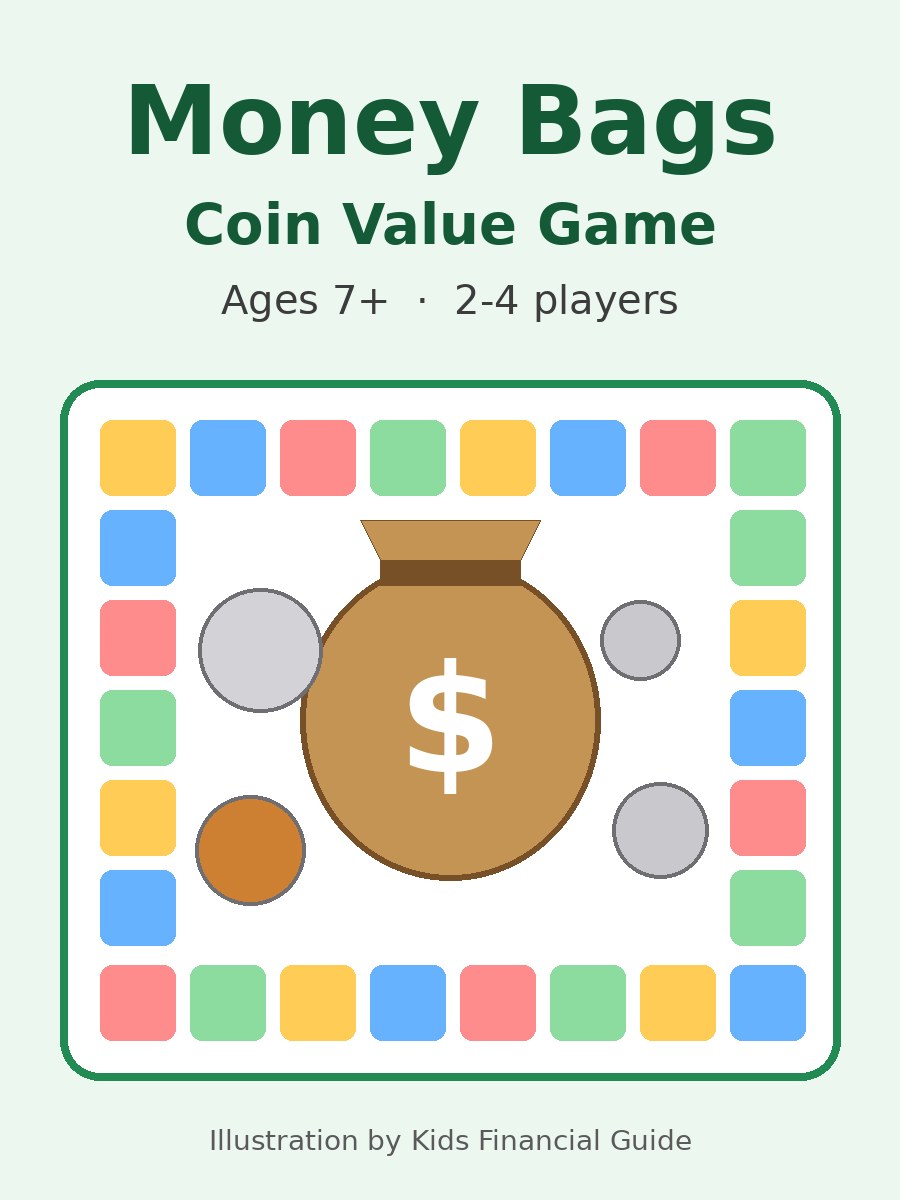
Money Bags is a roll-and-move board game. On your turn you roll the die, move, and take coins from the bank adding up to the amount on your space, but a spinner on the board tells you which coin you can't use (for example, no quarters). Landing on the $ space wins the Money Bags pot, and on a Change It Up! space you can trade small coins for a bigger coin or a bill and earn 10 cents interest. The game ends when someone reaches Finish; that player takes the pot, and the player with the most money wins.
The box includes 100 plastic coins, 10 play dollar bills, four game markers, one die and the game board with a built-in spinner. There are no cards to read and no app, so a child who can count can play after one explanation, and the maker says a game takes about 15 to 20 minutes.
The money lessons inside
The first skill is coin recognition. Pennies, nickels, dimes and quarters come up again and again, and children quickly learn that a bigger coin is not always worth more: a dime is smaller than a nickel.
The second is counting mixed money. Making 13 cents is easy with a dime; making it when the spinner says no dimes means thinking about nickels and pennies instead, and the game asks for that kind of counting on every turn.
The third is exchanging. Trading five pennies for a nickel, or four quarters for a dollar, teaches that the same amount can look different. Learning Resources notes the game does not include making change or subtraction, so it stops short of what happens at a real checkout.
Getting more learning out of game night
Add a store. Put price tags on a few toys or snacks and let players spend some of their winnings at the end. Ask them to pay the exact amount, then try paying with a bigger coin and work out the change together. That covers the skill the game leaves out.
Ask questions as you play: Can you show 25 cents in two different ways? Who has more money, and how much more? Would you rather have three dimes or one quarter, and why?
Move to real coins once your child is comfortable. Count a real piggy bank together, or let them pay for a small item at the store and check the change.
Who it's best for
Learning Resources labels Money Bags for ages 7 and up and 2 to 4 players, but in its customer answers it says the game works best for children around 5 to 7 who are just learning coins, and that children 8 and older may find it too simple. A 7-year-old who is still learning coins is the sweet spot; an older child who already counts money easily will need the store and change-making ideas above to stay interested. Keep the coins away from children under 3; there are 100 small pieces.
It suits families in the US who want a screen-free way to build coin confidence, and teachers looking for a small-group math center. It is a counting game, not a budgeting game; children ready for saving and spending decisions will get more from a game with real trade-offs.
Related Resources