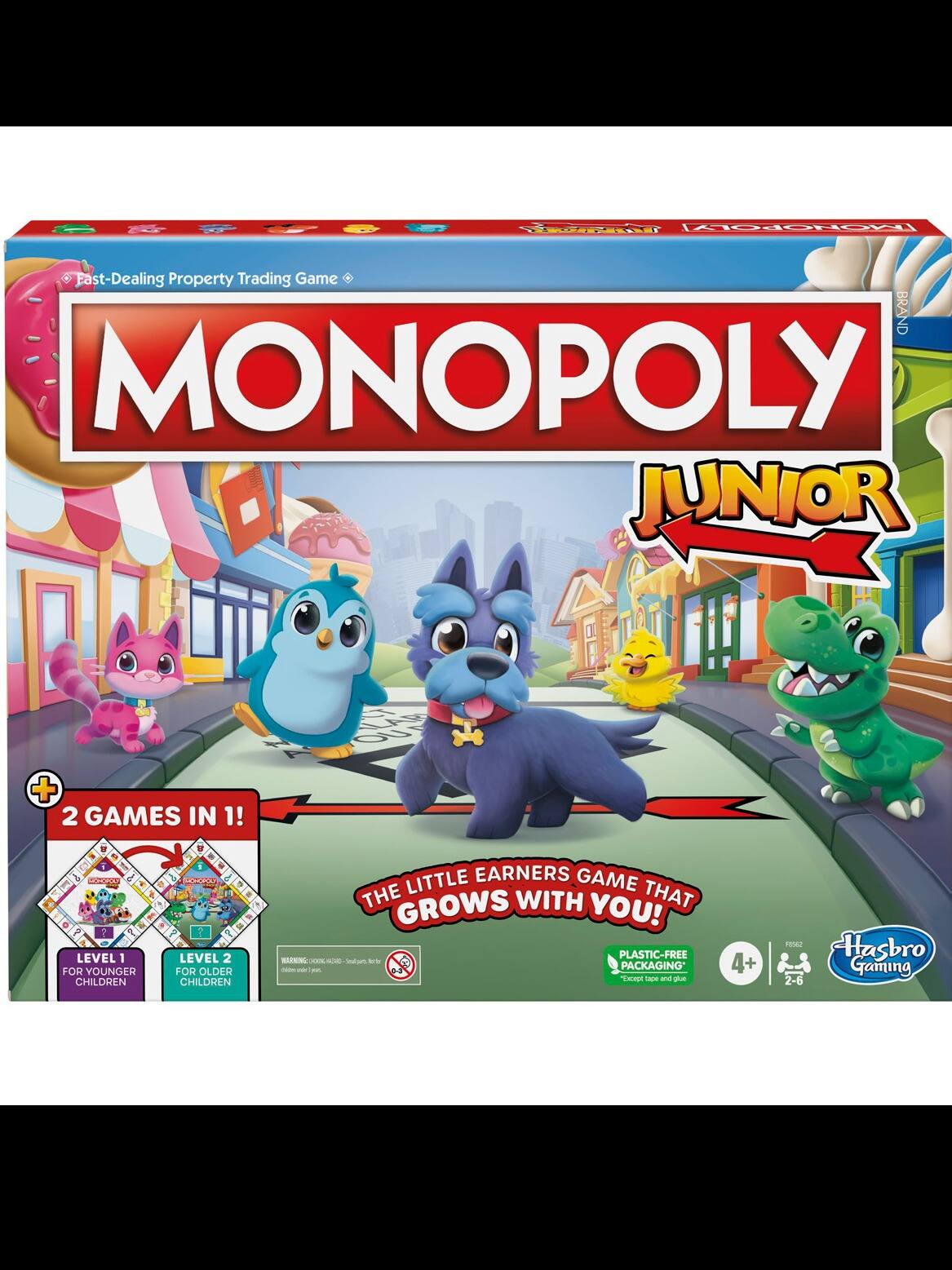
Monopoly Junior
By Hasbro | Ages 4+
Reviewed by Alex Thompson, founder of Kids Financial Guide · Updated October 2026
- Two-sided board: a counting game for 4-5s and a money game for 6+
- Level 2 gives lots of practice counting play money and paying rent
- Familiar rules most parents already know
- Few real choices about whether a purchase is worth it
- Level 1 has no money at all, so the money lessons start on the Level 2 side
- Small parts, not for children under 3
Topics Covered
Format
Board Game
Age Appropriateness
This resource is recommended for children aged 4+ years.
Players
2 to 6 players
Playtime
About 20 minutes
Game Type
Physical Game
Parental Involvement
Low
Our rating out of 5
Monopoly Junior: our in-depth review
How a game plays
Monopoly Junior is Hasbro's pared down version of the classic, and the current edition has a two-sided board that offers two games in one. Level 1 is for ages 4-5 and is about counting spaces and matching pictures as players buy properties; whoever owns the most properties wins. Level 2 is for ages 6 and up and adds Monopoly money, rent and reading. The same box can grow with a child or work for siblings of different ages.
On the Level 2 side, players roll a single die, move around a simpler board, buy properties and collect rent from anyone who lands on them. The player with the most money at the end wins. A game takes about 20 minutes.
The rules take little explaining, and most children can play on their own after one walk-through. It includes small parts and is not for children under 3, so keep pieces away from toddlers.
The money lessons inside
The clearest benefit is everyday math with money. On the Level 2 side, children count bills, add up what they owe and count spaces on the board. Doing this over and over in a game feels like play, but it builds fluency with numbers and simple amounts.
There is also a simple lesson in limited resources. Players have only so much cash, so they watch their pile shrink with every purchase and rent payment and grow when others land on their properties. That gives kids an early feel for money coming in and going out.
The main limitation is that buying is built into moving around the board, so there is little room to decide whether a purchase is worth it. That keeps the game fast and simple, but it builds money handling more than money decision making, so the strategy part is where a parent can add value.
Getting more learning out of game night
Let your child be the banker. Handling payouts and making change for everyone is the best arithmetic workout in the box, and older siblings can check each other's math. Before the first roll, count the starting money together so everyone knows what they began with.
Once your child knows the standard rules, try a house rule: let players decide whether to buy or pass, and talk about it each time. Questions to ask: Is this property worth it? How much will you have left? What happens if you land on an expensive space next turn? At the end, ask the winner and the others what helped and what they would change.
Bring the lessons outside the box. Count how much money each player has at the end and compare it to the start. Then link it to real life by asking where your family pays rent or a mortgage, or how a shop owner earns money when customers visit. Some children even enjoy designing their own board with local places and prices, which keeps the counting going in a creative way.
Who it's best for
Hasbro says Monopoly Junior is for ages 4 and up and 2 to 6 players. Level 1 suits 4 and 5 year olds, and the money lessons start on the Level 2 side at about 6. In our view it is at its best from about 4 to 8, when counting and simple money math are the skills being built. Older children will likely be ready for the full game or a game with more decisions.
It is a good choice for families who want a familiar, quick game that quietly builds math and money confidence. Many parents already know the rules, which makes it easy to play often. Pair it with the buy-or-pass house rule and a few post-game questions, and a casual game night becomes a solid first lesson in handling money.
Related Resources