Ages 10-14
Paperback, eBook
160
English
2024-04-23
9781523523436
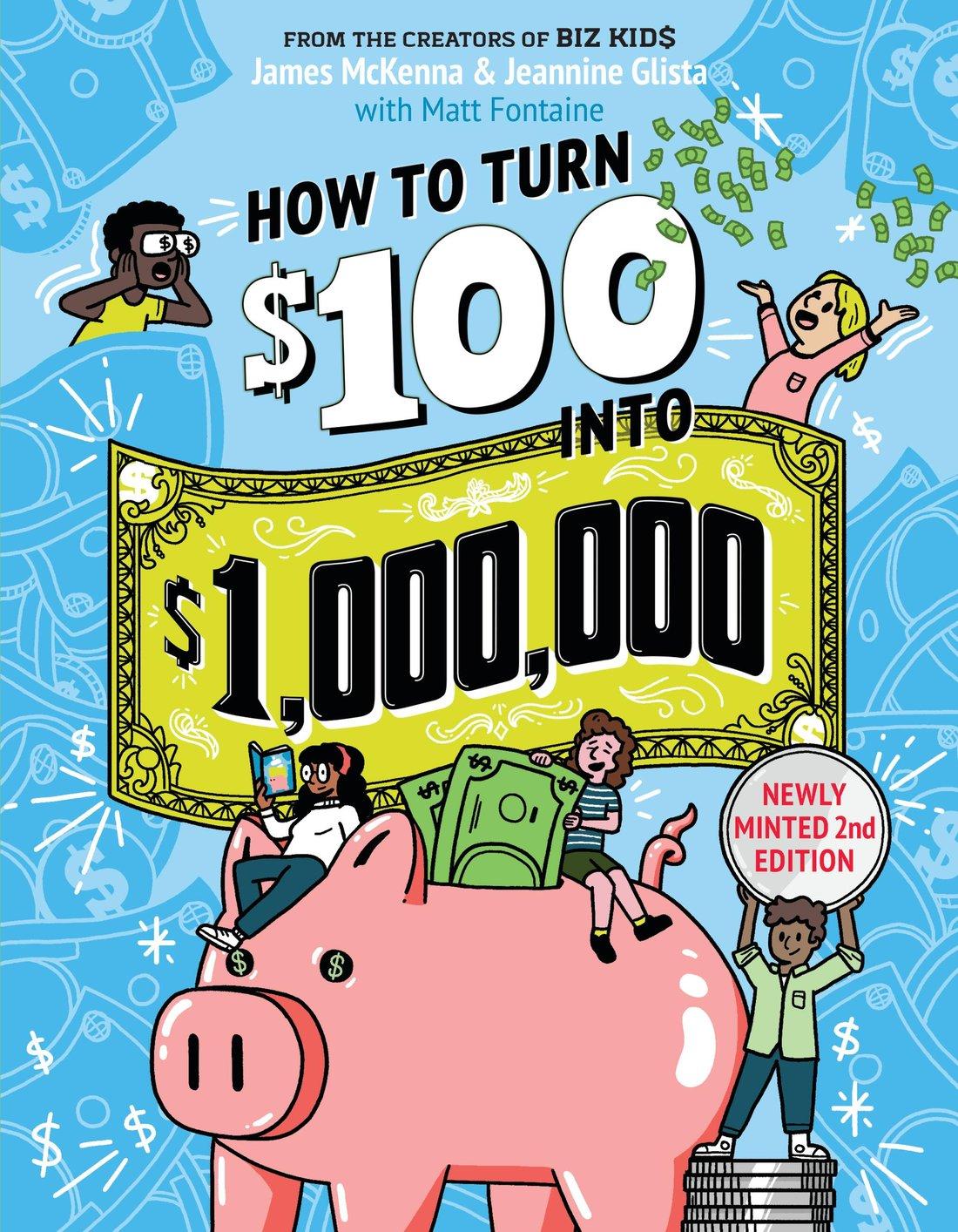
How to Turn $100 into $1,000,000
by James McKenna and Jeannine Glista, with Matt Fontaine
Reviewed by Alex Thompson, founder of Kids Financial Guide · Updated November 2026
The short answer
How to Turn $100 into $1,000,000 is the best first investing book we have found for ages 10 to 14: it explains earning, budgeting, the stock market and compound interest in a funny, illustrated 160 pages for $13.99. Read it alongside your child, because the title is a long-term goal rather than a promise, and stocks and Bitcoin can lose value.
| Ages | 10-14 (publisher) |
|---|---|
| Price | $13.99 paperback, $9.99 eBook (list prices) |
| Length | 160 pages, illustrated nonfiction |
| Edition | Newly Minted 2nd Edition, Workman Kids, April 2024 |
| Covers | Goals, budgeting, first jobs, starting a business, stocks, compound interest, Bitcoin |
| Authors | James McKenna and Jeannine Glista, with Matt Fontaine; McKenna and Glista co-created the TV series Biz Kid$ |
How to Turn $100 into $1,000,000 is an illustrated money guide for ages 10 to 14 by James McKenna and Jeannine Glista (with Matt Fontaine), co-creators of the Emmy-winning TV series Biz Kid$. The Newly Minted 2nd Edition (Workman Kids, 2024) covers setting goals, budgeting, getting a first job and writing a résumé, starting a small business, the stock market, compound interest and Bitcoin, with business-plan and budget templates kids can fill in.
Ratings
Educational Value
Engagement
Clarity
Practical Application
Value For Money
What Kids Will Learn
- 1Setting short-, medium- and long-term money goals
- 2Making and sticking to a simple budget
- 3Ways kids can earn money, from first jobs to a small business
- 4How compound interest makes savings grow over time
- 5What stocks are and how the stock market works
Parental Guidance
Tips for using this book:
- Read the book together and discuss the financial concepts presented
- Use the book as a starting point for conversations about money management
- Try out some of the activities and exercises with your child
- Connect the book's lessons to real-world experiences in your family
Full Review
Most money books for kids stop at the piggy bank. How to Turn $100 into $1,000,000 goes further. James McKenna and Jeannine Glista, the team behind the Emmy-winning TV series Biz Kid$, walk kids through setting goals, budgeting, earning (including first jobs, résumés and starting a business), and then the stock market and compound interest. The tone is light and the pages are illustrated, so it reads more like a funny magazine than a lecture, and the templates for a budget and a business plan give kids something to do. The 2024 Newly Minted edition updates the money information and adds Bitcoin. Two things to know as a parent: the title is a hook, not a promise, since turning $100 into a million takes decades of regular saving and investing; and stocks and crypto can lose value, so this is a book to read and discuss together. For a 10- to 14-year-old who is starting to earn and asking what investing means, it is the best place we know to start.
Our Verdict
Our take: this is our first pick for a tween who is ready to move past saving into investing. It gets the order right, earn, budget and save first, then invest, and it makes compound interest feel exciting. Pair it with a real conversation about risk, especially the Bitcoin pages, and with a small savings or investing goal your child can track.
How to Turn $100 into $1,000,000: our in-depth review
What the book teaches
The book follows the path its subtitle promises: earn it, save it, invest it. It starts with goals and budgeting, so kids learn to split money between what they want now, what they want later and what they want far in the future. It then turns to earning, with ideas for first jobs, how to write a simple résumé, and how to plan a small business, including a business-plan template.
The second half is about making money grow. Kids meet compound interest, the stock market and, in the 2024 edition, Bitcoin, along with stories of young entrepreneurs and self-made millionaires; remind your child that these are standout stories, not what usually happens. The idea that runs through it all is that starting early matters, because money invested young has the most years to grow.
About that title
The title is a hook, and it is worth explaining to your child. A single $100 does not become a million dollars by itself in a lifetime. If it earned an average of 7% a year (an assumption: stock returns go up and down from year to year, nothing is guaranteed, and savings accounts usually pay less), it would grow to about $197 in ten years and would take about 136 years to reach a million. What does work is adding money again and again over decades and letting compounding do the heavy lifting.
Compound interest means you earn interest on your interest, not just on the money you put in, so savings grow faster the longer you leave them. Investments such as stocks work in a similar way when their gains are left to grow, but they can also fall.
Investing comes with risk. The stock market goes down as well as up, and crypto such as Bitcoin can swing wildly or lose most of its value. Investments are not protected the way money in a savings account at an FDIC-insured bank is (the US government insures bank deposits up to $250,000 per depositor, per bank, if the bank fails). None of that is a reason to skip the book; it is a reason to read the investing chapters together.
Kids can't open a crypto or brokerage account themselves; any real investing happens in an account a parent opens and controls. Tell your child that anyone online promising to grow their money fast, or asking them to send money, gift cards or crypto, is running a scam.
Reading it together
This is a dip-in book rather than a cover-to-cover read. Let your child pick the chapter that matches what they care about now: earning money, a business idea or the stock market. Come back to the others when the topic comes up in real life, such as a first babysitting job or a question about the news.
Questions to talk about: What is something you want to save for this year, and something for when you are grown up? What could you do to earn money at your age? If you put money in a stock, what could make it go up or down? Why might someone who starts saving at 15 end up with more than someone who starts at 35?
For a hands-on start, split $10 (or 10 coins) into three piles: spend now, save for this year, and save for when you're grown up, and talk about why the last pile gets the longest to grow. If your child wants to start a business from the book, help them pick one that doesn't mean meeting strangers or selling online without you, and keep your home address and phone number off flyers and résumés.
Who it's best for
The publisher recommends it for ages 10 to 14. It is ideal for a tween who has some money of their own from an allowance, gifts or chores and is curious about what to do with it. Confident 9-year-olds can manage the earning and saving chapters with a parent; the résumé and job pages suit kids closer to 13 or 14.
If your child is younger or wants a story rather than a guide, start with a picture book about saving and come back to this one in a couple of years. If they have already read it and want more, pair it with a savings jar, a kids' savings account or, for an older child, a small custodial investing account that you open and manage together (the money legally becomes your child's, and they take control of it at 18 or 21 depending on your state), starting with money they can afford to see go down. Our guide to the best money apps for kids compares fees, parent controls and investing features. Many public libraries carry the book too; check that you get the 2024 Newly Minted edition.
Frequently asked questions
What age is How to Turn $100 into $1,000,000 for?
The publisher, Workman Kids, recommends it for ages 10 to 14. Confident readers of 9 can enjoy the earning and saving chapters with a parent, and the job and résumé pages suit kids closer to 13 or 14.
Can $100 really turn into $1,000,000?
Not on its own in a child's lifetime. If it earned an average of 7% a year (an assumption: stock returns go up and down from year to year, nothing is guaranteed, and savings accounts usually pay less), $100 would grow to about $197 in 10 years and would take about 136 years to reach a million. The book's real lesson is that saving and investing regularly, starting young, gives compounding (earning returns on past returns) decades to work.
Is How to Turn $100 into $1,000,000 a good book to teach kids about investing?
Yes. It is one of the few books for tweens that explains the stock market and compound interest, and it puts earning and budgeting first. The 2024 edition also covers Bitcoin, so talk with your child about risk: stocks and crypto can lose value, crypto prices can swing wildly, and kids can't buy either without an account a parent opens and controls.
What is the difference between the first and second editions?
The first edition came out in 2016. The Newly Minted 2nd Edition from April 2024 (ISBN 9781523523436) updates the money information and adds topics such as Bitcoin. Buy the 2024 edition so the examples are more up to date.
Is How to Turn $100 into $1,000,000 good for a 10-year-old?
Yes, for a 10-year-old who reads confidently and has some money of their own. The earning, budgeting and saving chapters fit well at 10; the résumé and job pages will mean more at 13 or 14, and the investing chapters are best read with a parent.
Related Resources