Ages 4-8
Paperback, audiobook
40
English
1994-11-15
9780688136345
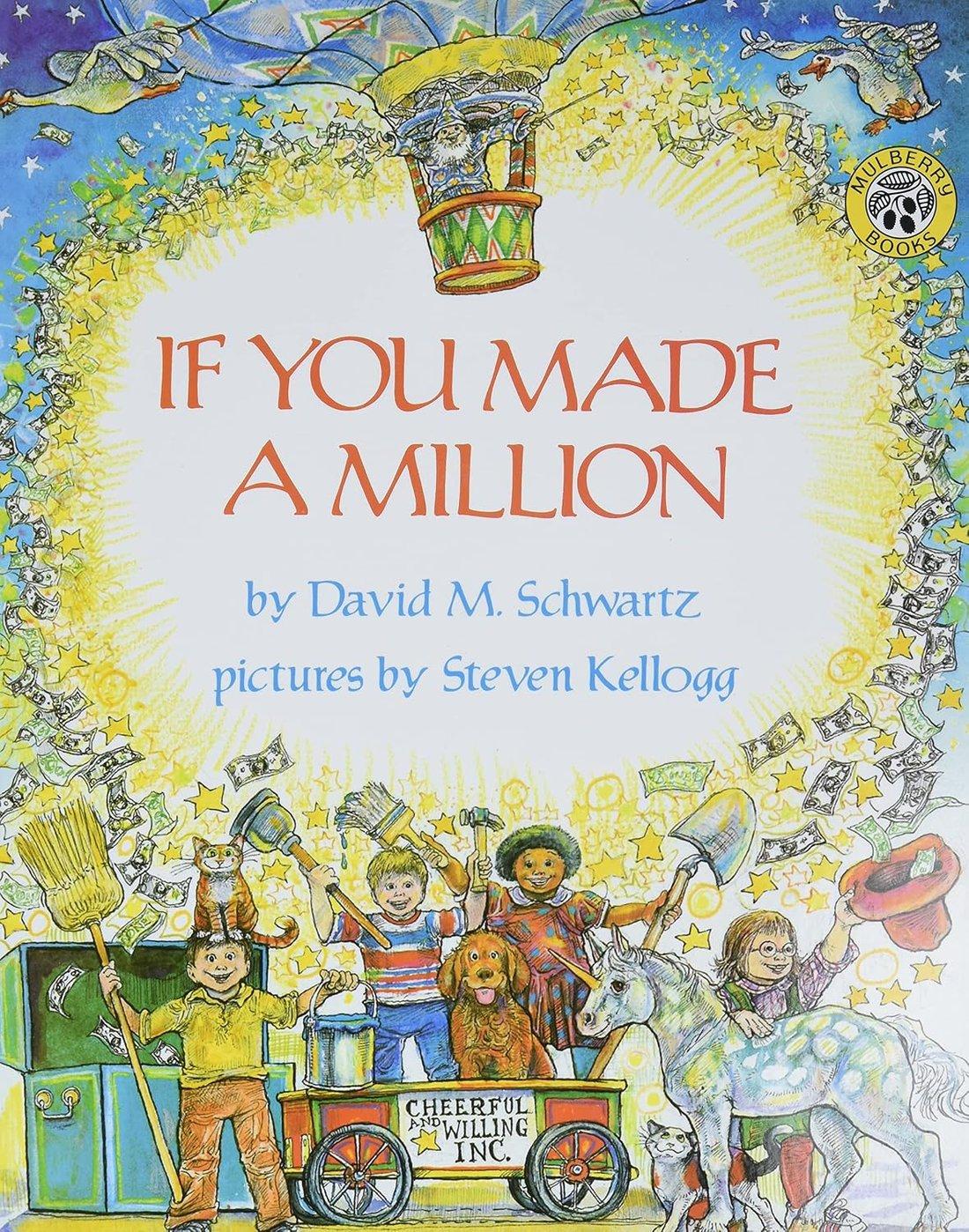
If You Made a Million
by David M. Schwartz, illustrated by Steven Kellogg
Reviewed by Alex Thompson, founder of Kids Financial Guide · Updated November 2026
The short answer
If You Made a Million is our pick of picture books for making big money numbers and bank interest feel real to kids about 5 to 10. Steven Kellogg's witty pictures help, and it costs $9.99 or nothing from the library; it dates from 1989, so it shows checks and no cards or apps, and its notes on compound interest are for older kids and parents.
| Ages | 4-8 (bookseller listing); Publishers Weekly suggested 6-10 |
|---|---|
| Price | $9.99 paperback (list price), or free from your library; also an audiobook |
| Length | 40-page picture book with notes for adults at the back |
| Edition | HarperCollins paperback, 1994 (first published 1989) |
| Covers | Earning, coins and bills, saving vs. spending, banks and interest, checks, loans, a first look at mortgages; notes on compound interest and income tax |
| Author | David M. Schwartz, author of How Much Is a Million?; illustrated by Steven Kellogg |
If You Made a Million is a 40-page picture book by David M. Schwartz, illustrated by Steven Kellogg, listed for ages 4 to 8 (Publishers Weekly suggested 6 to 10). Marvelosissimo the Mathematical Magician pays a group of kids for jobs, then shows how coins and bills add up, what a bank does, how interest grows savings, and what checks and loans are, with notes at the back on compound interest, checks, loans and income tax. First published in 1989; the HarperCollins paperback dates from 1994.
Ratings
Educational Value
Engagement
Clarity
Practical Application
Value For Money
What Kids Will Learn
- 1Different coins and bills can add up to the same amount
- 2Money is earned by doing work
- 3A bank keeps your money and pays interest on savings
- 4Borrowing money means paying it back, with interest
Parental Guidance
Tips for using this book:
- Read the book together and discuss the financial concepts presented
- Use the book as a starting point for conversations about money management
- Try out some of the activities and exercises with your child
- Connect the book's lessons to real-world experiences in your family
Full Review
If You Made a Million is a money book disguised as a magic show. Marvelosissimo the Mathematical Magician leads a group of kids through jobs that pay anything from a penny upward, then shows them what their earnings look like in different coins and bills, what a million dollars could buy, and how big a pile of money that would be. Along the way it explains what a bank does with your savings, how interest helps money grow, how a check works and what a loan is. Notes at the back go further, into compound interest, checks, loans and income tax. David M. Schwartz wrote it as the follow-up to How Much Is a Million?, and reviewers praised Steven Kellogg's illustrations as witty. Kirkus and Publishers Weekly both praised it when it came out, and it is still one of the few picture books to cover interest and borrowing at all. Its age shows in one way that matters: money here is coins, bills and paper checks, with no cards or apps, so it needs a short update from you. Read the story with younger kids and save the notes for 9- and 10-year-olds.
Our Verdict
Our take: this is our pick for a number-loving child who wants to know what a million really looks like and how banks make savings grow. Read it as a story first, then turn one page into a real-life question: what coins would make a dollar, or, with kids 7 and up, how much would you earn if a bank paid you interest? Add a sentence on cards and apps, because the book predates them.
If You Made a Million: our in-depth review
What the book teaches
The book starts small. The kids do jobs, such as feeding fish, and get paid, starting with a penny. Marvelosissimo shows that the same amount can come in different coins and bills, then scales up to a million dollars and what that much money would look like and buy.
From there it moves to what you can do with money besides spend it: keep it in a bank, where it earns interest, write a check to pay for something, or borrow money with a loan and pay it back. The notes at the back give adults and older kids more on compound interest (interest on your interest), checks, loans and income tax.
A 1989 book in a card-and-app world
The book first came out in 1989, and it shows. Money here is coins, bills and paper checks. There are no debit cards, apps or online banking, and some of the prices will look low to a child today. None of that makes the lessons wrong, but it does mean you should connect them to how your family actually pays.
A quick update: a debit card takes money straight out of a bank account, much like a check did, just faster. Payment apps work the same way when linked to a bank account, but money left sitting in an app may not be FDIC-insured. A credit card is a loan, so the borrowing pages apply to it: if the full bill isn't paid each month, you pay interest on what's left. Card numbers and PINs stay private, and a parent approves anything bought online or in an app. And interest still works the same way, though savings accounts pay under 1% a year on average (the FDIC's national average was about 0.4% in 2026) and around 4% at the best-paying online banks, so money grows slowly at first. Money in a savings account at an FDIC-insured bank is protected (the US government insures deposits up to $250,000 per depositor, per insured bank, for each ownership category, if the bank fails).
Reading it together
With 4- to 6-year-olds, read the jobs and coins pages and enjoy the pictures; skip the bank, interest, check and loan pages for now. With 7- and 8-year-olds, read it all and talk about interest and borrowing, keeping interest simple: the bank pays you a little extra for keeping your money there. With 9- and 10-year-olds, read the notes at the back together.
Questions to talk about (the last two suit kids about 7 and up): What job could you do at home or for family to earn your first dollar? Would you rather have a dollar now or more later? Why does a bank pay you to keep your money there? If you borrow money, why do you pay back more than you borrowed?
For a hands-on start tonight, put out a pile of coins. Younger kids can sort and name them; from about 7, see how many different ways your child can make one dollar. For kids about 7 and up, then ask what they would do with ten of those dollars: spend, save, or put in a bank to earn interest. At 4% a year, $10 earns about 40 cents in a year; at 0.4%, about 4 cents.
Who it's best for
Booksellers list it for ages 4 to 8, and it works best from about 5 to 10: younger kids enjoy the counting and the pictures, older ones get the interest and loans. It is ideal for a child who loves big numbers and math puzzles.
If your child likes it, How Much Is a Million? by the same team is a fun companion about big numbers. For a picture book that shows saving growing in a story, Rock, Brock, and the Savings Shock is a good next read. Many libraries carry If You Made a Million; the HarperCollins paperback (ISBN 9780688136345) is the edition to buy.
Frequently asked questions
What age is If You Made a Million for?
Booksellers list it for ages 4 to 8 (preschool to grade 3), and Publishers Weekly suggested 6 to 10 when it came out. Younger kids enjoy the jobs, the coins and the pictures; the interest, checks and loans make more sense from about 7, and the notes at the back suit 9- and 10-year-olds and parents.
Is If You Made a Million out of date?
In places. It first came out in 1989, so money means coins, bills and paper checks, with no debit cards, apps or online banking, and some prices will look low. The core ideas, earning, saving, interest and borrowing, still hold, so add a few words about how your family pays today.
Does If You Made a Million explain interest?
Yes. Marvelosissimo shows how money left in a bank earns interest, and the notes at the back explain compound interest, which means earning interest on your interest. Savings accounts today pay under 1% a year on average (the FDIC's national average was about 0.4% in 2026) and around 4% at the best-paying online banks, so growth is slow at first and speeds up over many years.
What is the difference between How Much Is a Million? and If You Made a Million?
Both are by David M. Schwartz and Steven Kellogg. How Much Is a Million? is about the size of big numbers, while If You Made a Million, the follow-up, is about money: earning it, counting it, saving it in a bank and borrowing it.
Related Resources