Ages 4-8
Paperback, hardcover, eBook; Spanish edition Alexander, que era rico el domingo pasado
32
English
1987-08-30
9780689711992
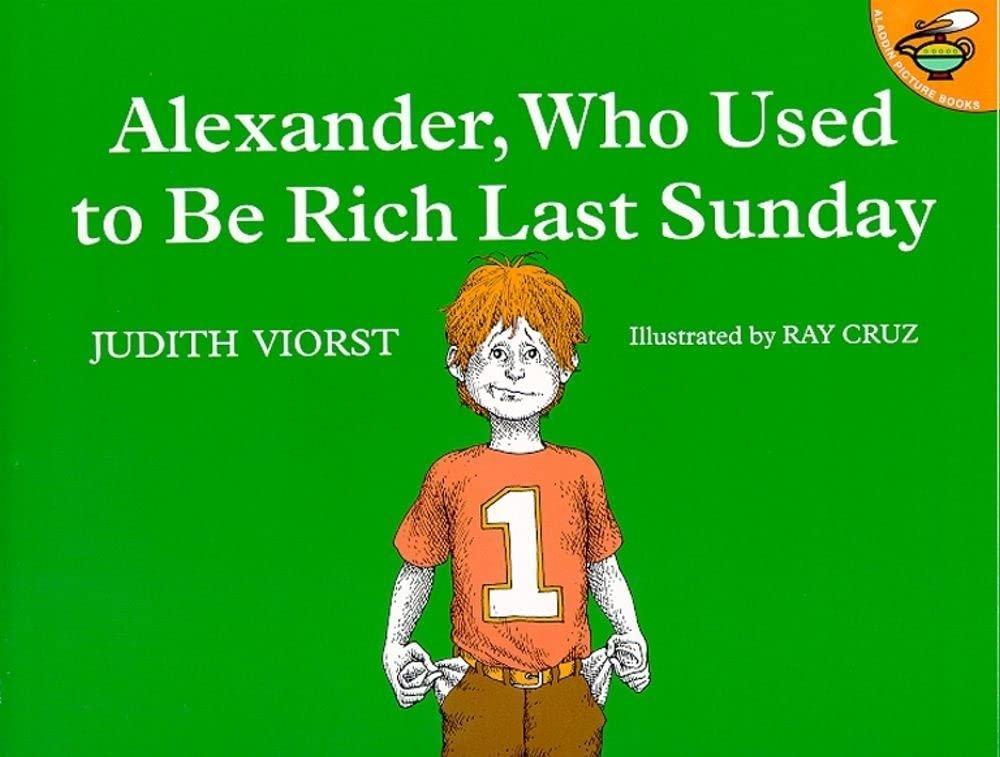
Alexander, Who Used to Be Rich Last Sunday
by Judith Viorst, illustrated by Ray Cruz
Reviewed by Alex Thompson, founder of Kids Financial Guide · Updated November 2026
The short answer
Alexander, Who Used to Be Rich Last Sunday is our pick for showing 4- to 8-year-olds how a dollar disappears a little at a time when you have a goal but no plan to stick to it. It is an $8.99 paperback, and a free Federal Reserve lesson plan turns the story into a counting and saving activity.
| Ages | 4-8 (publisher); the Federal Reserve lesson plan is for grades K-2 |
|---|---|
| Price | $8.99 paperback (list price), or free from your library |
| Length | 32-page picture book |
| Edition | Atheneum paperback, 1987 (first published 1978); Spanish edition Alexander, que era rico el domingo pasado (ISBN 9780689713514, listed for ages 6-9) |
| Covers | Spending a little at a time, saving for a goal, counting cents up to a dollar, opportunity cost |
| Author | Judith Viorst, illustrated by Ray Cruz |
Alexander, Who Used to Be Rich Last Sunday is a 32-page picture book for ages 4 to 8 by Judith Viorst, illustrated by Ray Cruz (Atheneum, first published 1978; this paperback 1987). Alexander's grandparents give him a dollar, and he wants to save it for a walkie-talkie. Instead it goes a few cents at a time: gum, lost bets, renting a snake, fines, a candy bar, a magic trick and a garage sale, until all he has left is bus tokens. There is a free K-2 lesson plan built on the story from the Federal Reserve Banks of St. Louis and Philadelphia.
Ratings
Educational Value
Engagement
Clarity
Practical Application
Value For Money
What Kids Will Learn
- 1Small spends add up
- 2Saving for a goal means saying no to some things now
- 3Counting cents up to one dollar (100 cents)
- 4Every choice to spend means giving up something else
Parental Guidance
Tips for using this book:
- Read the book together and discuss the financial concepts presented
- Use the book as a starting point for conversations about money management
- Try out some of the activities and exercises with your child
- Connect the book's lessons to real-world experiences in your family
Full Review
Alexander's grandparents give him a dollar, and he plans to save it for a walkie-talkie. By the end of the book, all he has left is bus tokens. In between, the money goes a few cents at a time: 15 cents on gum, 15 cents lost on bets, 12 cents to rent a snake, fines for saying bad words and for kicking, money he loses, a candy bar, a brother's magic trick and 20 cents at a garage sale. The Federal Reserve lesson plan adds it up: the cents come to exactly one dollar. That is what makes it a good money book. A young child can see that none of the amounts was large, yet the dollar is gone, and the walkie-talkie with it. It also gives real counting practice. The cons are small: the prices date from when the book was written, two losses are bets, and it shows only coins. Talk through those and it is a short, useful story about why saving takes a plan.
Our Verdict
Our take: this is our pick for showing young kids that small spends add up and that saving for something means saying no along the way. Read it, then add up Alexander's spending together with pennies (stay close with under-5s) or a pencil and paper, and ask what he could have done to keep enough for the walkie-talkie.
Alexander, Who Used to Be Rich Last Sunday: our in-depth review
What the book teaches
Alexander starts the book rich: his grandparents have given him a dollar. He wants to save it for a walkie-talkie. Then, one small choice at a time, it goes. Some spends are treats, like gum and a candy bar. Some are bad luck or bad choices, like losing bets and losing money. Some are fines, for saying bad words and for kicking.
The Federal Reserve lesson plan lists each amount, and together they make exactly one dollar. That is the lesson: none of the amounts was large, but with a goal and no plan to protect the money, the whole dollar is gone and the goal with it.
Adding up where the dollar went
With 6-year-olds, start with 100 pennies in ten piles of 10 and take out the right number for each spend. With 7- and 8-year-olds, write down each amount as you read and add them up together. Seeing 100 cents come out of many small numbers makes the idea stick.
With 4- and 5-year-olds, keep it to counting. Use 10 buttons or blocks as Alexander's dollar. Take one away for each thing his money goes on: gum, bets, the snake, the bad-words fine, the money he loses, the candy bar, the magic trick and the kicking fine, then two for the garage sale, his biggest spend. That makes 10 (the buttons count spends, not exact cents), and the dollar is gone (stay close with under-5s, since buttons and coins are a choking hazard). No buttons handy? Draw 10 circles and cross them out.
Reading it together
Before you start, explain what a walkie-talkie and a bus token are. Read it once for the story. On the second read, stop at each spend and ask: was that worth it?
Questions to talk about: What did Alexander want to buy? What happened to his dollar? Which spends would you skip? Why is betting a way to lose money? (When you bet, you can lose what you put in, and Alexander lost his bets.) What could he do next time to keep enough for the walkie-talkie?
For a hands-on start tonight, pick one small thing your child wants, write its price on a card, and keep the card next to their money. Before spending on something else, look at the card together.
Who it's best for
The publisher lists it for ages 4 to 8, and it fits best from about 5, when kids start to know their coins. It is a good pick for a child who gets money for birthdays and spends it fast.
For a story where a child spends her pocket change bit by bit and then starts saving, But I've Used All My Pocket Change is a gentler pick for ages 3 to 7. Many libraries carry Alexander, Who Used to Be Rich Last Sunday, and a Spanish edition, Alexander, que era rico el domingo pasado, is available.
Frequently asked questions
What age is Alexander, Who Used to Be Rich Last Sunday for?
The publisher lists it for ages 4 to 8, and the Federal Reserve lesson plan uses it with kindergarten to grade 2. Four- and five-year-olds can follow the dollar running out; 6- to 8-year-olds can add up where each cent went.
What does Alexander, Who Used to Be Rich Last Sunday teach about money?
It shows how a dollar disappears a few cents at a time when there is a goal but no plan to stick to it. Alexander means to save for a walkie-talkie, but gum, bets, fines and small treats use it all up. It also practices counting: the cents he spends add up to exactly one dollar.
Is there a free lesson plan for Alexander, Who Used to Be Rich Last Sunday?
Yes. The Federal Reserve Banks of St. Louis and Philadelphia publish a free K-2 lesson plan built on the book, covering saving, spending, savings goals and opportunity cost, with counting and bar-graph activities. It is free on the St. Louis Fed's website: search for "St. Louis Fed Alexander Who Used to Be Rich Last Sunday lesson".
Is Alexander, Who Used to Be Rich Last Sunday dated?
Some details are. A dollar buys a lot more in the story than it does today, and Alexander ends up with bus tokens and wants a walkie-talkie. The lesson still works: explain that prices were lower when the book first came out in 1978, and what a walkie-talkie and a bus token are, and focus on how small amounts add up.
Related Resources